
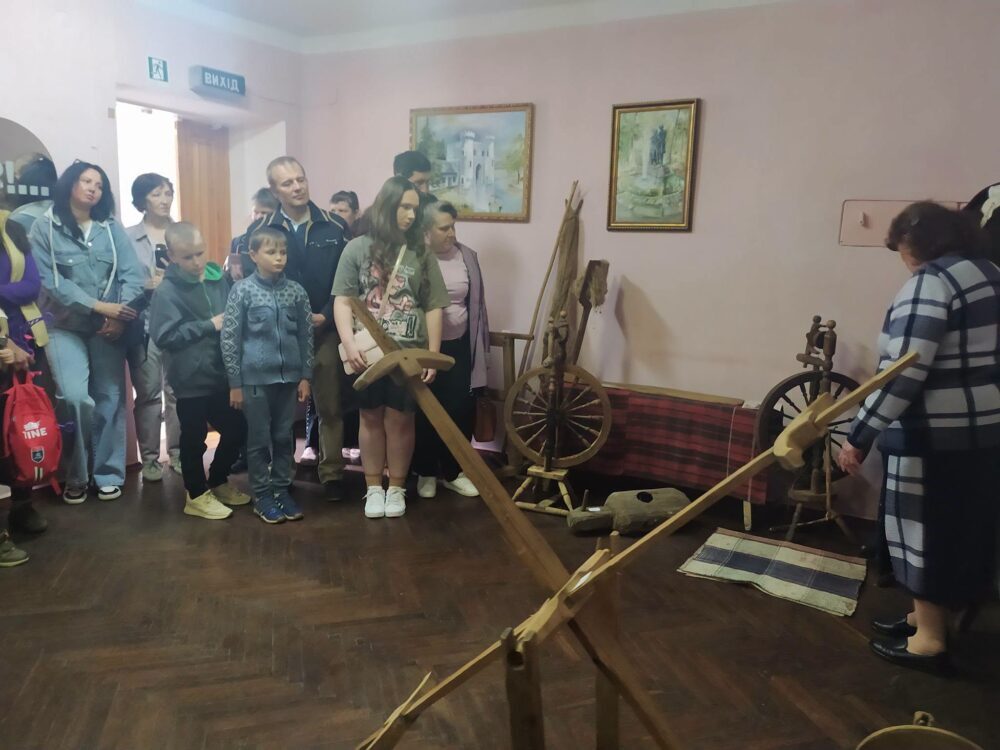
Presentation of the exhibition “Spinning – a folk craft with a centuries-old history”
editOn International Museum Day, May 18, guests at the historical museum got acquainted with the temporary exhibition “Spinning – a folk craft with a centuries-old history.”
The tour was conducted by the author of the exhibition, Lyudmila Kochegura, the chief custodian of the collections. She said that the Reserve’s treasury contains over 200 homespun products: tablecloths, ryadna, runners, rugs, etc., as well as shirts and towels made of flax and hemp. An important stage in their creation was the production of threads – spinning, which required considerable effort and consisted of several stages, including loosening, fumbling, combing, straightening, pulling, spinning.
Our former colleague Ivan Zakharenko shared his memories of helping his mother make threads as a child. After mechanical beating, the hemp was spread out in the yard or on the floor indoors and trampled with bare feet. This way, the woody particles of hemp were crushed (they were then shaken out), and the fiber became loose and soft. The work was not easy, especially for the children, because the woody hemp particles pricked their feet.
In the collection of funds, we have an interesting collection of tools used for making threads: spinning wheels, combs, combs, spindles, reels, reels, winders, skeins for winding threads into balls, brushes for combing out skeins before spinning, as well as samples of yarn and threads – over 70 museum items.
In Ukrainian villages until the 1960s, the ability to spin was considered mandatory for every girl or woman. Thread production was done in the autumn-winter period, except for Christmas. In a day, a craftswoman spun up to 300 m of thread from prepared fiber, and more than 1300 m of yarn was needed to produce 1 m of fabric.
In addition to its direct purpose, spinning also had a sacred meaning, and the process itself was accompanied by songs and rituals.